How to Read Your Hormone Test Results: A Guide to What You Are Looking At
You have done the test. The results are in your inbox, or on a piece of paper from the GP, or on a portal screen with a lot of numbers and some coloured flags. So what now?
Working out what each value reflects, what reference ranges do and don't mean, and what calls for action rather than reassurance is the part that tends to be left to women to figure out on their own. This is a guide to doing that.
The short version: read each result against three things, the reference range printed beside it, the point in your cycle when you took the test and your own earlier results. A result outside the range is a reason to repeat the test and talk it through with a clinician. A result inside the range can still mark a real change for you.
What does a reference range mean on a blood test?
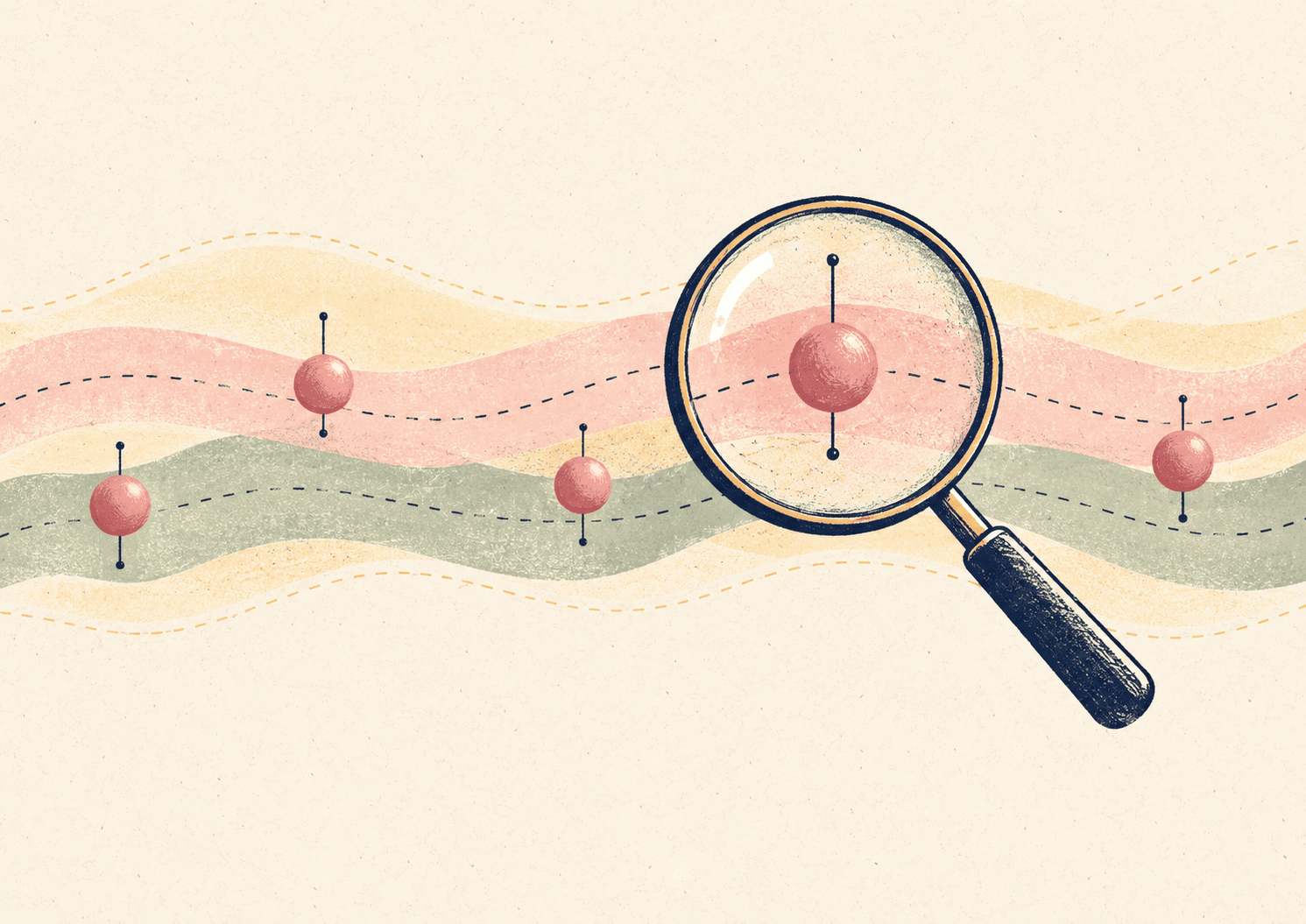
Every blood test result comes with a reference range, the span of values considered normal in a healthy population. Labs build these ranges from large datasets, and they cover roughly the middle 95% of values. They are useful, and they describe the population rather than you.
A result can sit comfortably inside the range and still represent a meaningful change for the woman it belongs to. Suppose your earlier results sat towards the top of the range and your latest one sits near the bottom. A population range cannot capture that change, and a personal baseline can.
Testing early and tracking over time turns individual results into information you and your doctor can use. Our piece on testing early explains the baseline idea.
What is a normal oestradiol level?
UK labs measure oestradiol in pmol/L (picomoles per litre). In the first half of a premenopausal cycle, the follicular phase, a typical range runs from about 75 to 600 pmol/L. After menopause oestradiol settles below 100 pmol/L, and usually below 50 pmol/L. During perimenopause values can swing across that whole spectrum and sometimes beyond it.
Timing makes a big difference. If you still have periods, Hysteron recommends testing between day 1 and day 12 of your cycle, counting the first day of your period as day 1. Testing in that same window each time gives you results you can compare from one test to the next. A result taken later in the cycle may reflect the normal rise and fall of the second half of the cycle rather than a meaningful change.
What do FSH results mean in perimenopause?
In the early follicular phase of a premenopausal cycle, FSH is typically between 2 and 10 IU/L. In research, early follicular values above 10 IU/L tend to be associated with a declining ovarian reserve, and values that stay above 25 to 30 IU/L are typically seen in late perimenopause and after menopause. These are population patterns, and what any one result means for you is a question for a clinician who knows your history.
FSH fluctuates a great deal during perimenopause, so a high result needs repeating before anyone draws conclusions from it, and no single result can confirm where you are in the transition. Our guide to FSH and LH blood tests goes into more detail.
What does progesterone show in a test taken early in your cycle?
Progesterone is made mainly after ovulation, so in the first half of the cycle it is naturally low. Low progesterone in a test taken between day 1 and day 12 is the pattern labs expect to see at that stage of the cycle, so a low reading there is not, on its own, a sign of a problem.
That makes an early-cycle progesterone result useful in a different way. It acts as a check on timing, since an unexpectedly high result can mean the sample was taken after ovulation, later in the cycle than you thought. It also gives you a baseline to compare with future tests, and once periods have stopped it stays low all month. If you take progesterone as part of HRT, your result will reflect that, so mention it when you go through your results with a clinician.
Progesterone measured early in the cycle can't show whether you ovulated. That needs a separate test about a week before your next period is due, around day 21 of a 28-day cycle, which a GP can arrange if it is relevant to you.
How do you read testosterone and free androgen index?
Labs report testosterone in women in nmol/L, and typical premenopausal female ranges run from roughly 0.3 to 2.0 nmol/L. The free androgen index, calculated from total testosterone and SHBG, gives a more reliable picture of the testosterone your body can use than total testosterone alone.
What should you do if your hormone results are abnormal or changing?
A result outside the reference range is a signal to pay attention, and where appropriate to repeat the test and look at it in context. It is no cause for panic. For women under 45, a raised FSH is usually repeated four to six weeks later, and a doctor looks at the results alongside symptoms when considering possibilities such as early menopause or POI.
A result inside the range that marks a meaningful shift from your own baseline also deserves attention. This applies most to FSH and oestradiol, where a steady trend up or down gives you and your clinician more to go on than any single in-range value.
Your results do the most good when you bring them to an appointment together with your previous results and your symptom history, so the conversation draws on all three. Keeping your results side by side over time, the idea behind the test at Hysteron, makes that conversation easier to have.
Questions women ask
What FSH level indicates menopause?
In research, FSH values that stay above 25 to 30 IU/L are typically seen in late perimenopause and after menopause. FSH fluctuates a lot during perimenopause, so a high result is usually repeated, and no single FSH result can confirm where you are in the transition. A GP or menopause specialist can tell you what your own results mean alongside your age and symptoms.
What is a normal oestradiol level in perimenopause?
During perimenopause oestradiol can swing across the whole spectrum, from premenopausal levels to post-menopausal ones and sometimes beyond. For comparison, a typical early follicular range before perimenopause is about 75 to 600 pmol/L, and after menopause levels settle below 100 pmol/L. Testing in the same window each time, between day 1 and day 12 if you still have periods, makes results easier to compare.
Should I worry if my result is outside the reference range?
Reference ranges cover the middle 95% of a healthy population, so a result outside them is a signal to pay attention and repeat the test, and no reason to panic. A raised FSH in a woman under 45 is usually repeated four to six weeks later. Bringing your results, earlier results and symptom history to your doctor gives the fullest picture.
References
NICE. (2019). Menopause: diagnosis and management. Guideline NG23.
Burger HG, et al. (2007). A review of hormonal changes during the menopausal transition. Human Reproduction Update, 13(6): 559–565.
British Menopause Society. (2023). Interpreting hormone levels in menopause. thebms.org.uk
Ready to know your normal?
Choose your testKeep reading.
 Biomarker Testing
What Are Biomarkers? And What Can They Tell You About Your Health?
What a biomarker is, the hormone and metabolic markers that matter in menopause, and why one test at one point in time has its limits.
4 min read
 Biomarker Testing
Should You Get Your Blood Tested for Perimenopause? The Case for Testing Early
Why testing early sets your own baseline, why tracking over time tells you more than one result, and what a useful perimenopause blood panel includes.
6 min read
 Hormones
FSH and LH: What These Hormones Tell You About Menopause
Why a single FSH result can't tell the whole story in perimenopause, what FSH and LH measure, and why tracking over time gives a clearer picture.
3 min read