Your Thyroid and Menopause: Why They Get Confused All the Time
Type a list of midlife symptoms into a search bar and two explanations tend to stare back, perimenopause and a thyroid disorder. The two share so many symptoms that one can easily pass for the other, and they often turn up in the same years of life. Symptoms alone rarely settle the question, which is why clinicians often look at thyroid function alongside reproductive hormones, and it is also possible to have both at once.
It is one of the most common muddles in women's midlife health, and the overlap has a cause. Thyroid conditions are more common in women, they become more common with age, and they tend to develop in the very years when your reproductive hormones are also changing.
Which symptoms do thyroid problems and menopause share?
An underactive thyroid, known as hypothyroidism, shares a long list of symptoms with perimenopause. Fatigue, weight gain, brain fog, mood changes, dry skin and hair, and disrupted sleep can all come from either source.
An overactive thyroid, or hyperthyroidism, overlaps with a different set. Palpitations, anxiety, sweating and feeling intolerant of heat can all turn up with perimenopause or with an overactive thyroid, as well as with other causes. With that much common ground, it is easy to see why one condition so often looks like the other. Our guide to the full list of menopause symptoms sets out the full range.
How can you tell thyroid symptoms from perimenopause?
Clinicians know a few features that tend to lean one way or the other. Hypothyroidism is often associated with cold intolerance, constipation and slowed reflexes. Hyperthyroidism tends towards weight loss despite a normal appetite, diarrhoea and a fine tremor in the hands.
The pattern of heat is another thing a clinician will ask about. Menopausal hot flushes come in episodes, while the heat of an overactive thyroid tends to feel more continuous. These are tendencies, plenty of women do not fit them neatly, and blood markers give a GP far more to go on than any list of symptoms.
Why do thyroid problems often start around perimenopause?
Most thyroid disorders in women are autoimmune, which means the immune system mistakes part of the body for a threat. Hashimoto's thyroiditis, the most common cause of an underactive thyroid, involves the immune system damaging the thyroid gland.
Autoimmune conditions become more common with age. As a result, thyroid changes often surface in exactly the years when reproductive hormones are shifting for other reasons. The two conditions can exist side by side, and each can make the symptoms of the other feel worse.
Which thyroid blood tests are useful?
A thorough thyroid assessment starts with TSH, or thyroid-stimulating hormone, as the main screening marker. Free T4 and free T3, the thyroid hormones themselves, add detail if TSH is abnormal. Thyroid antibodies can be raised before TSH moves out of range, which gives a clinician context that a TSH result alone would miss.
If you are weighing up a menopause blood panel, our guides to what biomarkers are and whether a perimenopause blood test is right for you explain what a useful panel can include.
Thyroid medication and HRT
Oestrogen raises levels of a protein called thyroid-binding globulin. More of your thyroid hormone then sits bound to that protein, leaving less available for your body to use. For women who take levothyroxine, starting HRT can mean their usual dose has less effect than before.
If you take thyroid medication and are considering HRT, it is worth raising with whoever prescribes it. Clinicians commonly recheck thyroid function a few months after oestrogen therapy begins, so the dose can be reviewed if needed.
Seeing your thyroid markers next to your reproductive hormones, and watching how both change over time, gives you and your doctor a clearer starting point. What we test sets out how we build that picture of your own normal.
Questions women ask
Can thyroid problems be mistaken for perimenopause?
They can. An underactive thyroid shares fatigue, weight gain, brain fog, mood changes, dry skin and hair, and poor sleep with perimenopause. An overactive thyroid shares palpitations, anxiety, sweating and heat intolerance, so symptoms alone often cannot separate the two.
Can you have thyroid problems and perimenopause at the same time?
Both can happen together. Thyroid disorders in women are mostly autoimmune and become more common with age, so they often appear in the same years as perimenopause. Each condition can make the symptoms of the other feel worse.
Does HRT affect thyroid medication?
Oestrogen raises thyroid-binding globulin, which leaves less thyroid hormone free for your body to use. For women on levothyroxine, starting HRT can make their dose less effective, and clinicians commonly recheck thyroid function a few months after oestrogen therapy begins.
References
Boelaert K & Franklyn JA. (2005). Thyroid hormone in health and disease. Journal of Endocrinology, 187(1): 1–15.
Perini L, et al. (2020). Thyroid disorders and menopause: a systematic review. European Thyroid Journal, 9(3): 152–160.
Ready to know your normal?
Choose your testKeep reading.
 Foundations
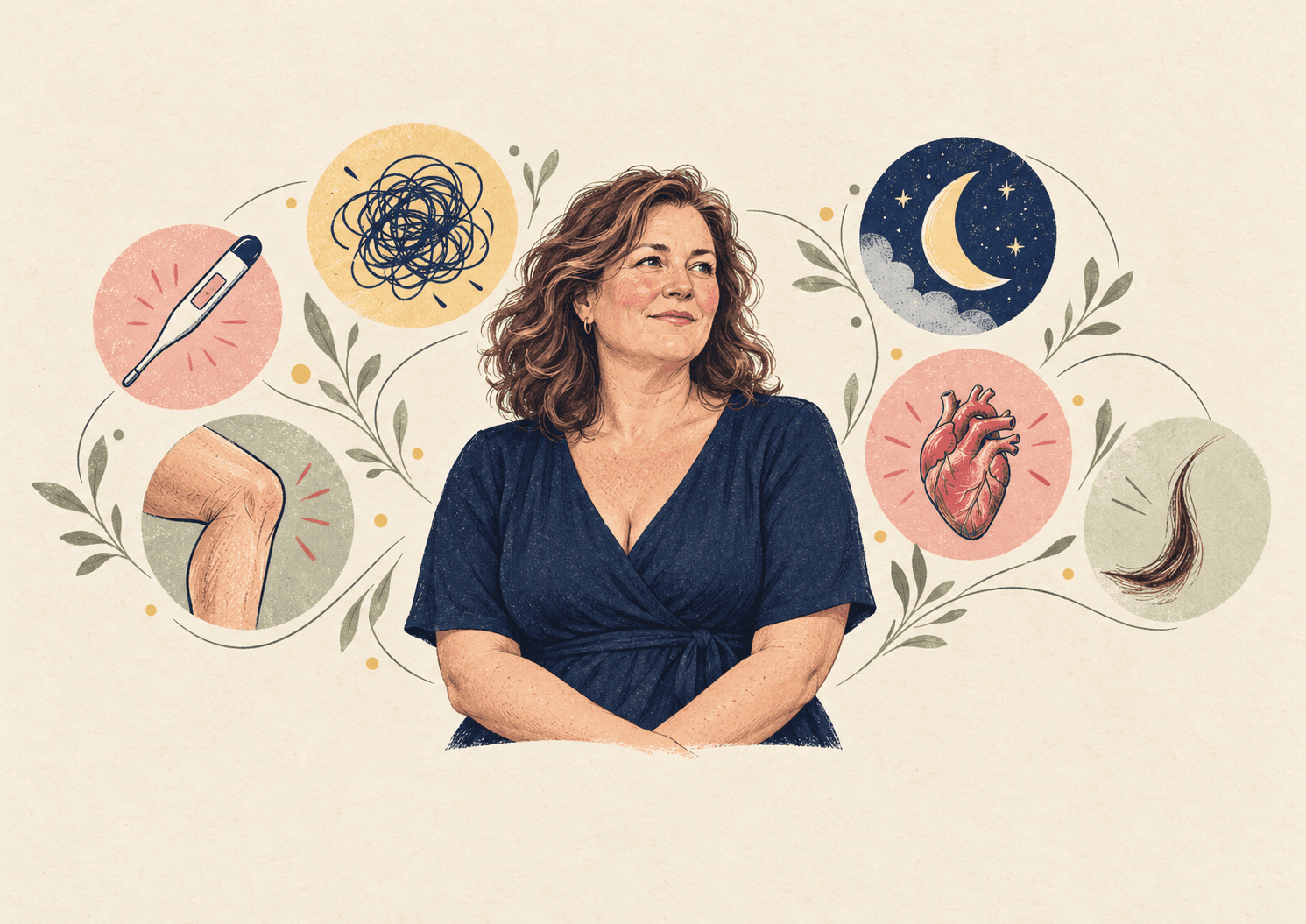
Menopause Symptoms: The Full List
From brain fog and joint pain to palpitations and dry skin, the full list of menopause symptoms, including the ones most women are never told about.
3 min read
 Biomarker Testing
Should You Get Your Blood Tested for Perimenopause? The Case for Testing Early
Why testing early sets your own baseline, why tracking over time tells you more than one result, and what a useful perimenopause blood panel includes.
6 min read
 Biomarker Testing
What Are Biomarkers? And What Can They Tell You About Your Health?
What a biomarker is, the hormone and metabolic markers that matter in menopause, and why one test at one point in time has its limits.
4 min read