Exercise in Menopause: Why Strength Training Matters Now
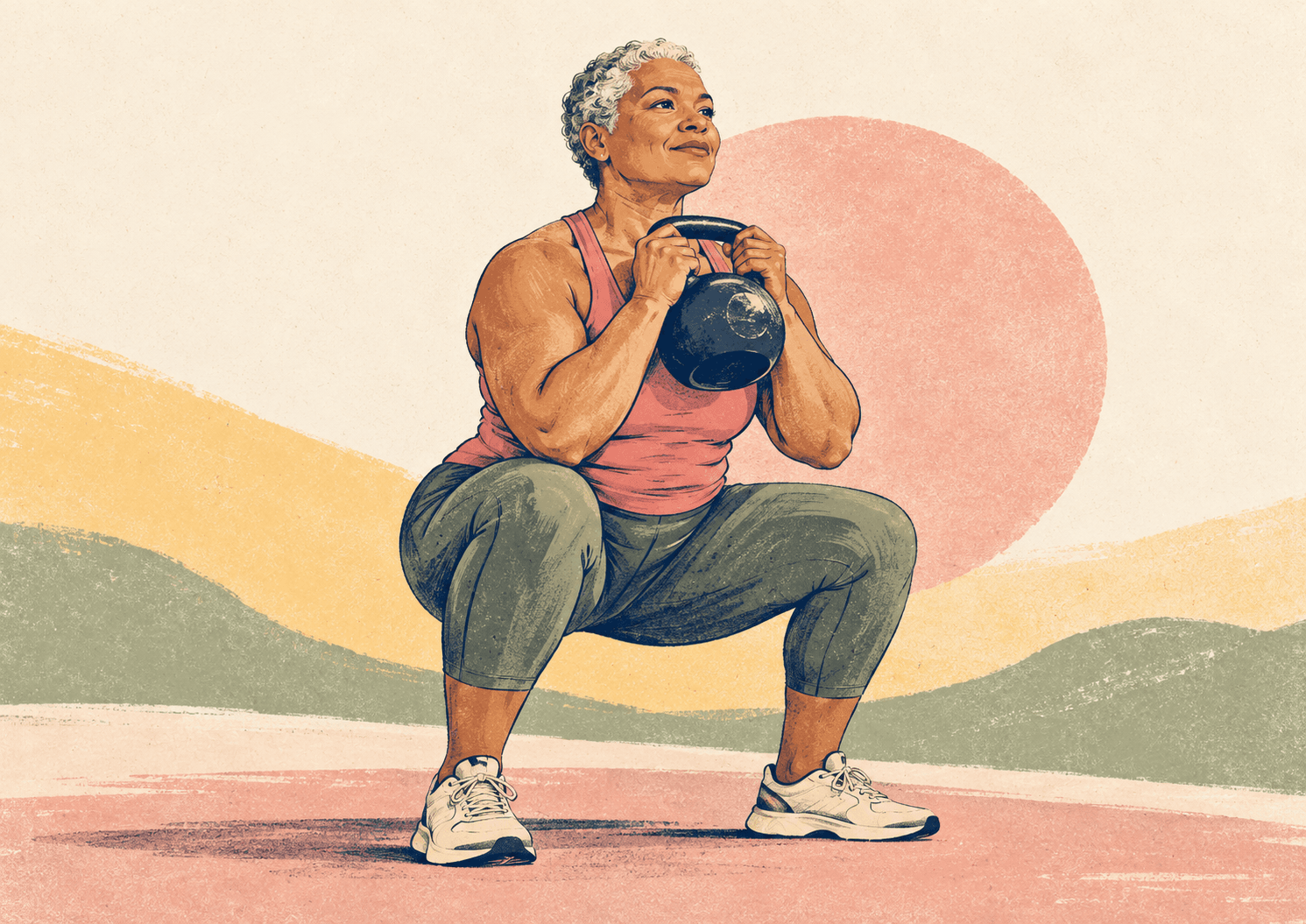
Plenty of women arrive at midlife with a loyal running habit or a standing yoga class, then wonder why it no longer seems to be doing what it used to. Strength training earns a special place in menopause because it works on two changes the transition sets in motion, the loss of muscle and the loss of bone that follow falling oestrogen. Cardio, walking, yoga and Pilates all keep their value, yet the research on lifting against a heavy, progressive load goes further for bone and muscle than most women have been told.
"Exercise more" is advice almost everyone has heard and most people follow in a vague, general way. Menopause gives it a sharper purpose. You are exercising to counter specific physiological changes happening in your body now, rather than for some hazy benefit decades down the line.
What does cardio do for you in menopause?
Running, cycling, swimming and brisk walking bring real benefits at this stage of life. They support your heart, lift your mood, help you think clearly, improve sleep and help your metabolism, so they deserve a regular place in your week.
Cardio falls short on the musculoskeletal side of menopause. As oestrogen withdraws and testosterone declines relative to it, women lose muscle mass and bone density, and aerobic exercise does little to hold that loss back.
Why does strength training matter more after menopause?
Resistance training means working your muscles against a load heavy enough to challenge them, and increasing that load over time. The effort puts mechanical stress through your bones, and bone responds by building new tissue.
After menopause your body breaks bone down faster than before, and resistance training pushes directly against that loss. Our guide to osteoporosis and bone density covers the bone side in more depth.
The LIFTMOR trial, published in the Journal of Bone and Mineral Research in 2018, tested high-intensity resistance and impact training in post-menopausal women who already had osteopenia or osteoporosis. The women gained significant bone mineral density at the spine and hip. With appropriate supervision in place, the researchers found no increase in injury risk.
Muscle is the other half of the story. Resistance training preserves and builds skeletal muscle, which supports your metabolic rate and your insulin sensitivity. Combined with aerobic exercise, it helps you keep muscle while you lose fat, including visceral fat, the deep fat stored around the organs.
There is evidence too that it improves mood, thinking and energy. If your shape has been changing, our piece on weight gain in menopause explains the hormonal background.
What counts as strength training?
The load has to challenge you. By the final few repetitions of each set the weight should feel hard, and if you could carry on comfortably all the way through, it is too light.
You have plenty of formats to choose from. Some women prefer free weights and machines in a gym, or barbell and kettlebell work. Others use a reformer Pilates machine with the springs set heavy, or follow a resistance band programme at home.
UK guidelines advise strength exercise on at least two days a week. If lifting is new to you, one or two sessions with a qualified personal trainer can set up your technique, and feeling confident in your form makes it much easier to keep showing up. Food plays its part in building muscle too, and our menopause nutrition guide covers that side.
Should you give up yoga, Pilates and walking?
You can keep all three. Each has real value in menopause, and nobody needs to stop doing them. They do not produce the same gains in bone density and muscle mass as progressive resistance training, so specialists suggest adding strength work alongside whatever you already enjoy.
If you want to see how your body responds over time, tracking markers such as vitamin D, cholesterol and HbA1c alongside how you feel gives you something concrete to measure against. You can see the full list in what we test.
Questions women ask
Is strength training safe if I have osteoporosis?
In the LIFTMOR trial, post-menopausal women with osteopenia and osteoporosis did high-intensity resistance and impact training under supervision. They gained bone mineral density at the spine and hip, and the researchers found no increase in injury risk. Supervision was part of that trial, which is one reason a few sessions with a qualified trainer can help if you are starting out. If you have a bone density diagnosis, your GP or a physiotherapist can talk through what suits you.
How often should I lift weights in menopause?
UK guidelines advise strength exercise on at least two days a week. The load should feel difficult by the last few repetitions of each set. If it feels comfortable throughout, it is time to go heavier.
Is walking enough exercise in menopause?
Walking supports your heart, mood, sleep and metabolism, so it is well worth keeping up. It does not build bone density and muscle mass the way progressive resistance training does. Adding strength work covers the gap walking leaves.
References
Watson SL, et al. (2018). High-intensity resistance training improves bone mineral density. Journal of Bone and Mineral Research, 34(1): 14–23.
Villareal DT, et al. (2017). Aerobic or resistance exercise in dieting obese older adults. New England Journal of Medicine, 376: 1943–1955.
NICE. (2015, updated 2024). Menopause: identification and management. Guideline NG23.
UK Chief Medical Officers. (2019). UK Chief Medical Officers' Physical Activity Guidelines. gov.uk
Ready to thrive in midlife?
Book my testKeep reading.
 Symptoms
Weight Gain in Menopause: What Is Actually Happening (And Why Eating Less Isn't the Answer)
Falling oestrogen changes where your body stores fat and how it uses energy. Why eating less often isn't the answer, and what the evidence suggests.
4 min read
 Long-Term Health
Osteoporosis After Menopause: What Happens to Your Bones and What Helps
Bone loss speeds up around menopause, often without symptoms. How menopause affects bone, who is most at risk and what the evidence supports.
4 min read
 Lifestyle
Menopause Nutrition: What to Eat, What to Avoid, and Why It Matters
Protein, calcium, vitamin D and the eating patterns with the strongest evidence. A practical guide to nutrition through perimenopause and menopause.
3 min read