Skin and Hair in Menopause: What Oestrogen Was Doing All Along

Women often notice it in small ways first, such as a wider parting, a moisturiser that suddenly stings or more hair in the plughole than there used to be. Menopause does change skin and hair, and drier, thinner skin and thinning hair are both linked to the fall in oestrogen that runs through perimenopause and the years after it. Some of what you see in the mirror in your 40s and 50s is ordinary ageing, and a good share of it is hormonal.
That distinction is useful. Hormonal changes call for more targeted responses than the generic anti-ageing advice on most beauty counters, and knowing the mechanism helps you choose what to spend your time and money on.
What does oestrogen do for your skin?
Oestrogen stimulates the production of collagen, the structural protein that keeps skin firm and springy. It also drives the making of hyaluronic acid, which holds water in the skin and gives it plumpness and moisture.
When oestrogen falls, collagen goes with it, and fast. Research has found that skin loses up to 30% of its collagen in the first five years after menopause, far quicker than the usual age-related decline. That speed explains why so many women say their skin seemed to change almost overnight.
Oestrogen also supports the skin barrier, the outer layer that keeps moisture in and irritants out, and it has anti-inflammatory properties that help your skin tolerate the world around it. After menopause skin becomes drier, thinner, more sensitive and slower to heal. If products you have used for years suddenly sting, the drop in oestrogen may be part of the reason. You can read more about the hormone's wider role in our guide to oestrogen and menopause.
Why does hair thin during menopause?
One of the main drivers of hair thinning, heavier shedding and a wider parting at this stage is a change in the balance between androgens and oestrogen. As oestrogen falls, androgens such as DHT gain the upper hand. On the scalp they shorten the hair's growth cycle and, over time, shrink the follicle itself. The result is diffuse thinning that can look very like androgenetic alopecia, the pattern of hair loss more often associated with men.
The same mechanism produces the opposite result elsewhere on the body. Follicles on the face and body respond differently to androgens, so some women notice new, unwanted facial or body hair at the same time as their scalp hair thins. Skin and hair changes both appear on our full list of menopause symptoms.
What helps skin and hair in menopause?
HRT has good evidence for improving the collagen content and hydration of skin in menopausal women. HRT is a wider health decision with benefits and risks to weigh, so it belongs in a conversation with your GP or menopause specialist.
Skincare priorities tend to shift at this stage. Richer moisturisers support a weakened barrier, and gentle cleansing avoids stripping it further. Consistent SPF earns its place, since UV exposure speeds up the collagen loss that falling oestrogen has already set in motion. Topical retinoids have good evidence for stimulating collagen production.
For thinning hair, topical minoxidil, available over the counter in the UK, has the best evidence for female pattern hair loss. Iron deficiency is a frequently missed contributor, especially in perimenopausal women whose periods have become heavier. Low ferritin, the measure of your iron stores, is linked with hair loss even when you are not anaemic. Your GP can check your iron levels, and our guide to menopause nutrition covers eating well through the transition.
Skin and hair shift gradually, and so does the chemistry behind them. Knowing your own normal and watching how it changes over time gives you, and any clinician you see, a fuller picture to work from, which is the idea behind the test.
Questions women ask
Does menopause make your skin age faster?
Research has found that skin loses up to 30% of its collagen in the first five years after menopause, faster than normal age-related decline. Falling oestrogen also reduces hyaluronic acid and weakens the skin barrier. Skin tends to become drier, thinner, more sensitive and slower to heal.
Is hair loss in menopause caused by hormones?
Hormones are often part of it. Falling oestrogen shifts the balance towards androgens such as DHT, which shorten the hair growth cycle and shrink follicles on the scalp, and the result can look like pattern hair loss. Low iron stores can also contribute, especially where periods have been heavy, so the cause is worth exploring with your GP.
Does HRT help skin?
HRT has good evidence for improving collagen content and hydration in the skin of menopausal women. It carries wider benefits and risks, so it is a decision to talk through with your GP or menopause specialist.
References
Thornton MJ. (2013). Estrogens and aging skin. Dermato-Endocrinology, 5(2): 264–270.
Shapiro J & Wiseman M. (2000). Practical management of hair loss. Canadian Family Physician, 46: 1469–1477.
Calleja-Agius J, Muscat-Baron Y & Brincat MP. (2007). Skin ageing. Menopause International, 13(2): 60–64.
Ready to thrive in midlife?
Book my testKeep reading.
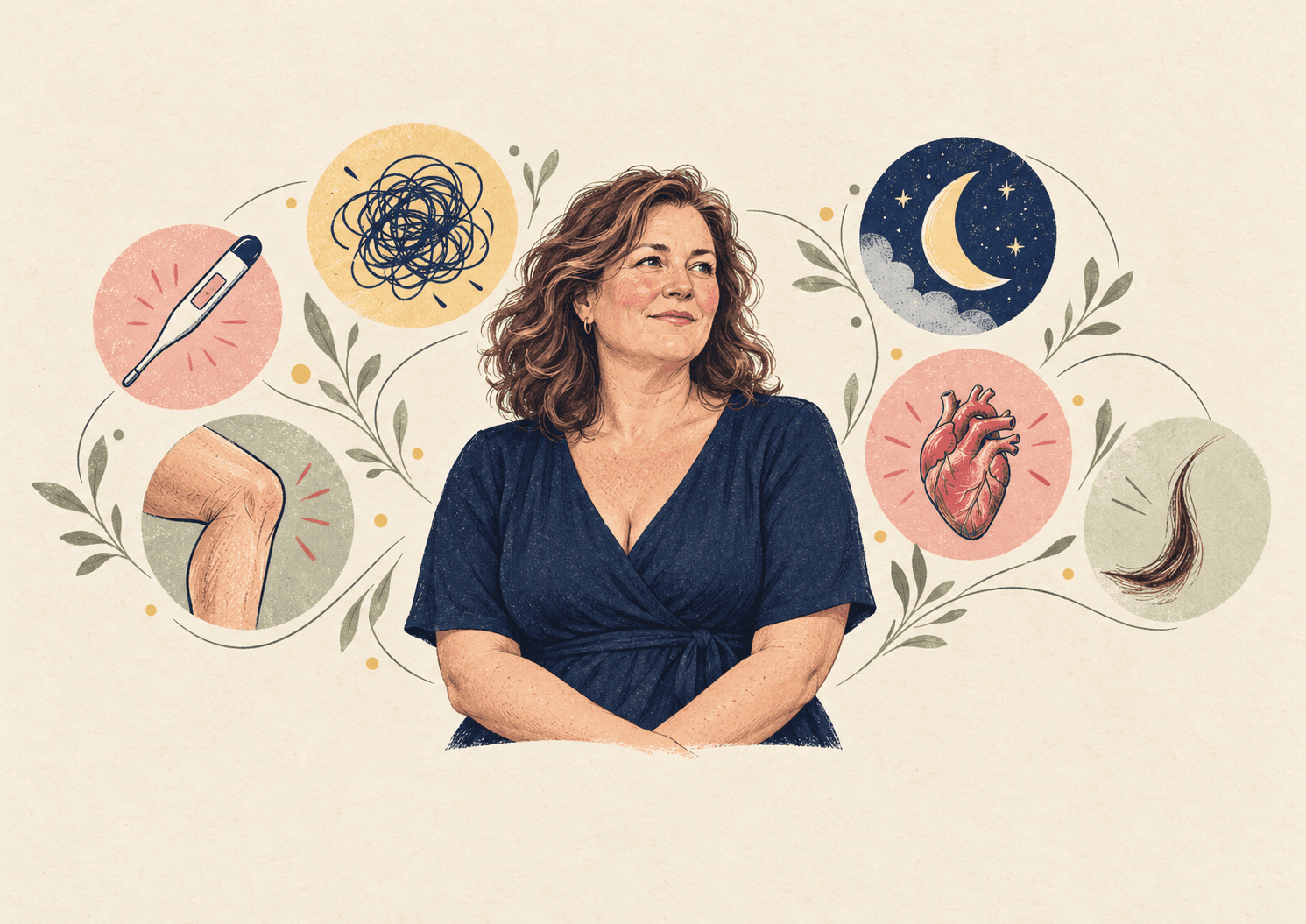 Foundations
Menopause Symptoms: The Full List
From brain fog and joint pain to palpitations and dry skin, the full list of menopause symptoms, including the ones most women are never told about.
3 min read
 Hormones
Oestrogen: What It Does, Why It Matters, and What Happens When It Falls
Oestrogen does far more than run your cycle. What it does for your brain, heart, bones and skin, and what changes as levels fall in perimenopause.
4 min read
 Lifestyle
Menopause Nutrition: What to Eat, What to Avoid, and Why It Matters
Protein, calcium, vitamin D and the eating patterns with the strongest evidence. A practical guide to nutrition through perimenopause and menopause.
3 min read