Types of HRT: Patches, Gels, Tablets and Body-Identical Options
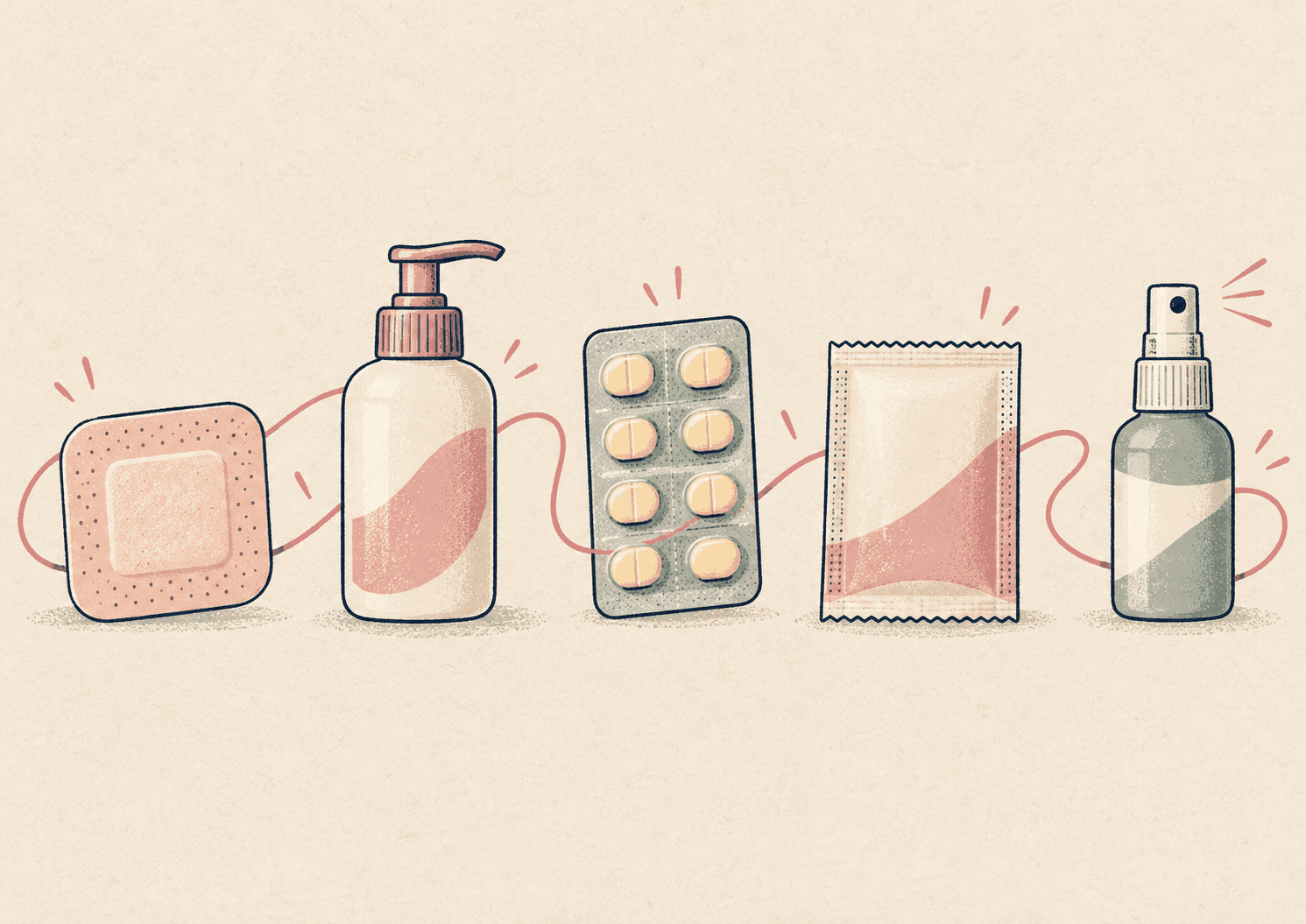
Say "HRT" to a room of women and you will hear about patches that peel off in the shower, gels that take an age to dry and friends who swear by a spray. That is because HRT comes in several forms. Patches, gels and sprays go on the skin, tablets are swallowed, and creams, pessaries and rings work inside the vagina.
Each route changes how your body absorbs the hormones, what the risks look like and how the treatment fits into your day. The labels add another layer, since "body-identical" and "bioidentical" sound almost the same yet describe products that are made, tested and overseen in very different ways.
Knowing how the options differ gives you a fuller conversation with your GP or menopause specialist, and a better sense of the questions to ask. If you are new to HRT altogether, our guide to what HRT is covers the basics first.
What is transdermal HRT?
Transdermal means "through the skin". Patches sit on the lower abdomen, buttocks or thigh, and you change them once or twice a week depending on the product. They release oestradiol at a steady, continuous rate.
Gels go on once a day, usually on the inner arm or thigh, and they give more room to adjust the dose than a fixed-dose patch. Sprays work on the same principle and are applied to the inner forearm.
The main clinical difference between these three and tablets lies in the liver. Oestrogen absorbed through the skin passes straight into the bloodstream without a first trip through the liver, so it does not trigger the changes in clotting factors linked with oral oestrogen.
Research, including a 2007 study published in Circulation, found that transdermal oestrogen does not carry the raised risk of blood clots (venous thromboembolism, or VTE) seen with tablets. That difference carries extra weight for women with a past history of clots or with cardiovascular risk factors, and it explains why current UK practice leans towards the transdermal route.
Are HRT tablets still prescribed?
Yes. Oral oestrogen tablets remain in wide use and are effective for relieving symptoms and protecting bone. They pass through the liver first, and that first pass accounts for their link with a higher risk of VTE. For women without a raised clot risk or other specific reasons to avoid them, guidelines regard tablets as a reasonable option, while generally listing transdermal oestrogen as the first choice. Your GP or menopause specialist can explain how that balance applies to your own history.
Why do you need progesterone with HRT if you have a womb?
Guidelines pair systemic oestrogen with a progestogen for anyone who still has a uterus. Several types of progestogen exist, and they do not all behave in the same way.
Micronised progesterone, sold in the UK as Utrogestan, is body-identical, meaning its structure matches the progesterone your ovaries make. It behaves differently from synthetic progestogens in breast tissue, the cardiovascular system and the brain. It has shown a lower breast cancer risk signal than some older synthetic progestogens and a more favourable profile for mood and sleep.
Taken at night, it has a mild sedative effect through the brain's GABA receptors, which some women with disturbed sleep find helpful. If you have questions about the progestogen in your prescription, your GP or menopause specialist can talk you through the options and how they compare.
What is vaginal oestrogen and how is it different?
Vaginal oestrogen treats the tissues of the vagina and urinary tract directly, and very little of it reaches the rest of your circulation. It comes as creams (Ovestin, Gynest), pessaries (Vagifem, Imvaggis) and a vaginal ring (Estring).
It is the first-line treatment for genitourinary syndrome of menopause, the term for the dryness, discomfort and urinary changes that often follow menopause. Most women can use it, including many who cannot take systemic HRT, and guidelines do not call for a progestogen alongside it, even for women who have a womb.
What does body-identical HRT mean?
Body-identical HRT means licensed, regulated medicines containing hormones with the same molecular structure as the ones your body makes. It uses oestradiol for the oestrogen part and micronised progesterone for the progestogen part. UK examples include Oestrogel, Lenzetto spray, Evorel patches and Utrogestan, so several of the patches, gels and sprays described above fall into this group.
These products are available on NHS prescription. Manufacturers make them to pharmaceutical quality standards, researchers have tested them in clinical trials, and the MHRA regulates them.
This is what menopause specialists and NICE guidelines mean when they talk about body-identical HRT. Its advantage over older formulations comes from how closely it resembles your own hormones, both in the way it binds to receptors and in the way your body breaks it down.
Is bioidentical HRT the same thing?
Usually not, and the confusion comes from several directions. The two terms are near twins, people use them in different ways in different settings, and commercial interests have muddied the picture of what counts as a legitimate preparation. The word "bioidentical" has no regulated meaning, so on its own it tells you nothing about safety or effectiveness.
In practice, "bioidentical" most often refers to compounded bioidentical hormone replacement therapy, shortened to cBHRT. Compounding pharmacies mix these preparations to order. Clinics typically base them on individual hormone testing and formulate them to a personalised profile. Private clinics are the main outlet, and the preparations can be expensive.
Is compounded bioidentical HRT safe?
The central clinical concern with cBHRT is that it lacks the regulatory oversight and clinical evidence that licensed preparations have. Compounding pharmacies do not work to the same manufacturing standards as pharmaceutical manufacturers, so you have no guarantee of an accurate dose or of consistency from one batch to the next. No clinical trial data exist on the safety and effectiveness of these specific preparations.
The British Menopause Society, the International Menopause Society and the Endocrine Society all state that cBHRT should not be recommended over regulated body-identical preparations. Regulated body-identical HRT, such as transdermal oestradiol and micronised progesterone, has clinical trial evidence and MHRA oversight behind it.
If you are weighing up hormone therapy, or a clinic has offered you a compounded product, your GP or a menopause specialist can explain how the options compare and what fits your circumstances. Our guide on how to talk to your GP about menopause covers what to bring and what to ask.
Questions women ask
Which type of HRT is safest?
The answer depends on your own health history. Transdermal oestrogen, given as a patch, gel or spray, bypasses the liver and has not been linked with the raised clot risk seen with tablets, which is why UK practice tends to favour it. Your GP or menopause specialist can weigh up the options with you.
Is HRT gel better than patches?
Gels and patches both deliver oestradiol through the skin and share the advantage of bypassing the liver. You apply a gel every day, and it allows more flexibility with the dose, while a patch releases a steady amount and you change it once or twice a week. The difference comes down to dosing and what fits your routine.
Is body-identical HRT the same as bioidentical HRT?
No. Body-identical HRT refers to licensed products such as Oestrogel, Evorel patches and Utrogestan, which have been tested in clinical trials, are regulated by the MHRA and are available on NHS prescription. "Bioidentical" often describes compounded hormones made up by compounding pharmacies, which do not have that oversight or trial evidence.
Do I need progesterone with vaginal oestrogen?
Usually not. Vaginal oestrogen acts locally and very little enters the wider circulation, so guidelines do not call for a progestogen with it, even for women who have a womb. Systemic oestrogen is a different matter, and guidelines pair it with a progestogen for anyone with a uterus. Your GP or menopause specialist can confirm what applies to your prescription.
References
NICE. (2019). Menopause: diagnosis and management. Guideline NG23.
Canonico M, et al. (2007). Hormone therapy and venous thromboembolism. Circulation, 115(7): 840–845.
British Menopause Society. (2023). Types of HRT. thebms.org.uk
British Menopause Society. (2019). BMS statement on bioidentical hormones. thebms.org.uk
Endocrine Society. (2016). Bioidentical hormones: a position statement. JCEM, 101(4): 1318–1343.
Ready to know your normal?
Choose your testKeep reading.
 Treatment
What Is HRT? A Clear, Balanced Guide
What hormone replacement therapy is, how it works, the different types, and a balanced look at benefits and risks so you can make an informed choice.
4 min read
 Treatment
How to Talk to Your GP About Menopause (Including What to Say If You Get Dismissed)
What to bring, what to ask for and what to say if you feel dismissed. A practical guide to getting more from a GP appointment about perimenopause.
4 min read
 Foundations
Menopause Symptoms: The Full List
From brain fog and joint pain to palpitations and dry skin, the full list of menopause symptoms, including the ones most women are never told about.
3 min read