Joint Pain in Menopause: Why Your Joints Ache and What Helps
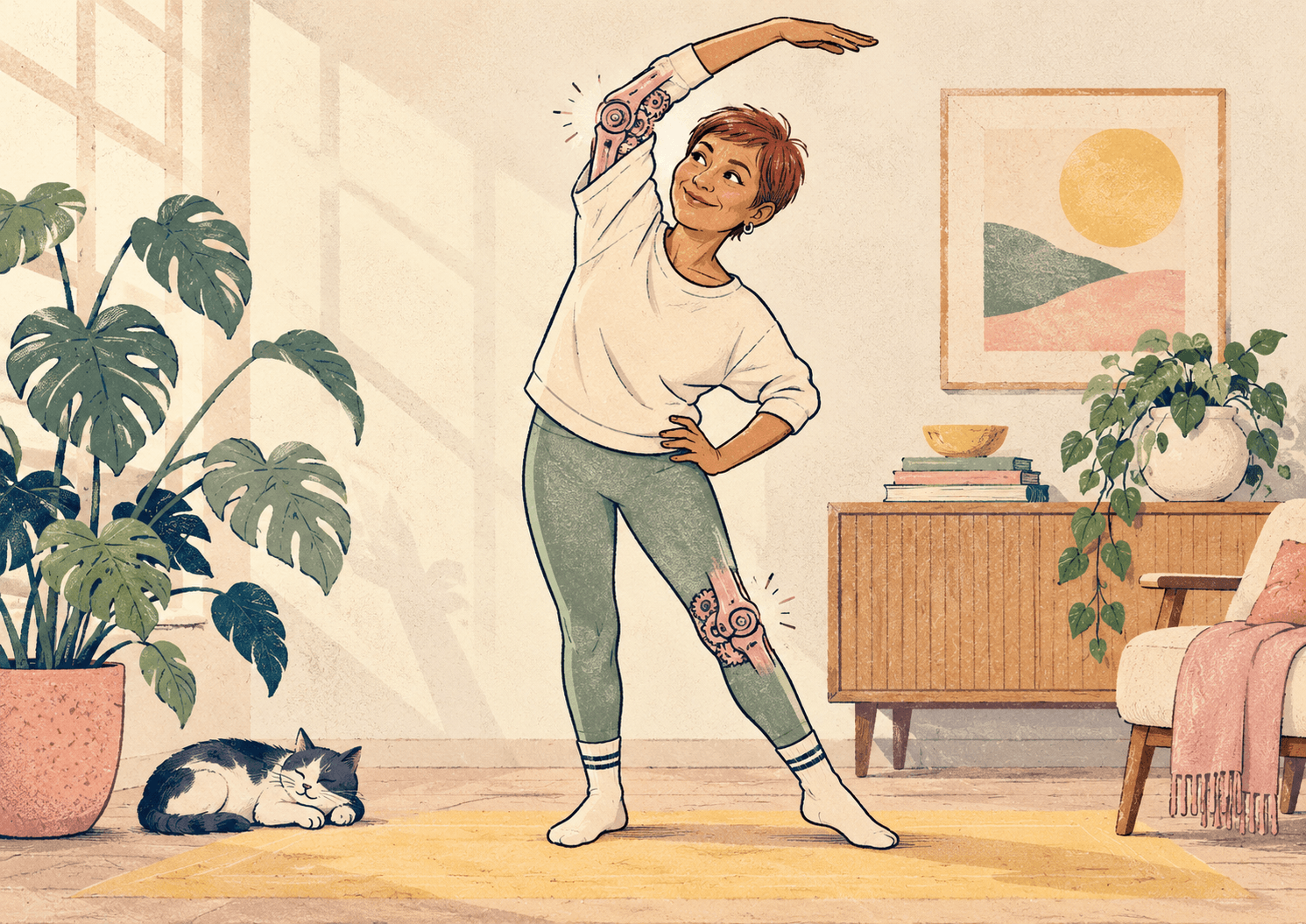
Joint pain can be part of perimenopause. Stiff fingers in the morning, aching knees and sore hips are common during the transition, and falling oestrogen is one of the reasons. Joint pain affects more than half of women around the time of menopause, which makes it one of the most common symptoms of the transition.
Plenty of women take the long road to that answer. Many describe painful fingers and knees, a referral to rheumatology to look into rheumatoid arthritis or early osteoarthritis, and a parting line of "everything looks normal for your age".
Those checks have real value, as you will see below, although hormones can go unmentioned the whole way through. Joint pain sits on the full list of menopause symptoms, even if it rarely makes the headlines.
Can perimenopause cause joint pain?
Your joints are full of places where oestrogen acts. Researchers have found oestrogen receptors in cartilage, in bone, in the synovial tissue that lines each joint and in the structures around it. Oestrogen has anti-inflammatory properties and helps keep cartilage healthy and joints well lubricated.
Research suggests that as oestrogen falls, some of that protection is lost and inflammation in the joints tends to rise. That may help explain a pattern many women recognise, where pain and stiffness arrive quite suddenly in early perimenopause in someone who never had joint trouble before. The hands, knees and hips are the places it most often shows up.
For more on the many jobs this hormone does, see our guide to what oestrogen does in your body.
Why do my fingers hurt in perimenopause?
Painful, swollen finger joints are a recognised pattern in perimenopause, and they can look very like the early stages of inflammatory arthritis. That overlap is why, when sore hands turn up alongside other perimenopausal symptoms, a clinician will usually weigh up several possible explanations, with hormonal change among them.
Is it menopause or arthritis?
It can be either, and it can be both, and working out which is a job for a clinician since each points to different options. Where there is doubt, a doctor may arrange blood tests that give information on inflammation and arthritis-related antibodies, usually rheumatoid factor, anti-CCP antibodies, ESR and CRP.
What those results mean for you, and where to look next, is part of that conversation with your doctor.
What helps menopause joint pain?
HRT containing oestrogen has evidence behind it for joint pain. In the Women's Health Initiative trial, women taking oestrogen-only HRT reported joint pain a little less often than women taking a placebo. HRT suits some women and not others, depending on health and personal history, so it belongs in a conversation with your GP or menopause specialist.
Movement matters in a way that can feel counterintuitive when your knees hurt. Rest eases joint pain in the short term only.
Strong muscles around a joint take some of the mechanical load off the cartilage, and a mix of low-impact cardiovascular exercise and resistance training supports both your muscles and your joints. Our guide to strength training in menopause covers what counts and how to start.
Vitamin D is the other piece of the picture. Deficiency is common in the UK and contributes to musculoskeletal pain in its own right. Your GP can check your level and advise on supplements if it turns out to be low.
Joint pain in midlife seldom has a single cause, and one set of results only shows you a moment in time. Knowing your own normal, and how it shifts through the transition, gives you and your doctor more to go on, which is the thinking behind what we test.
Questions women ask
Is joint pain an early sign of perimenopause?
It can be one of them, although joint pain has many possible causes. Pain and stiffness can appear quite suddenly in early perimenopause, often in the hands, knees and hips, in women who had no joint problems before. Joint pain affects more than half of women around the time of menopause.
Does HRT help with joint pain?
In the Women's Health Initiative trial, women taking oestrogen-only HRT reported joint pain a little less often than women taking a placebo. HRT is a personal decision that depends on your health and history, so talk it through with your GP or menopause specialist.
Should I rest or exercise if my joints hurt in menopause?
Rest helps joint pain in the short term only. Keeping the muscles around your joints strong reduces the mechanical load on cartilage, and low-impact cardiovascular exercise combined with resistance training supports both muscle and joint health.
References
Magliano M. (2010). Menopausal arthralgia: fact or fiction. Maturitas, 67(1): 29–33.
Barnabe C, et al. (2008). Sex and menopausal status influence the prevalence of peripheral arthritis. Journal of Rheumatology, 35(9): 1810–1815.
NICE. (2015, updated 2024). Menopause: identification and management. Guideline NG23.
Chlebowski RT, et al. (2013). Estrogen alone and joint symptoms in the Women's Health Initiative randomized trial. Menopause, 20(6): 600–608.
Ready to thrive in midlife?
Book my testKeep reading.
 Foundations
Menopause Symptoms: The Full List
From brain fog and joint pain to palpitations and dry skin, the full list of menopause symptoms, including the ones most women are never told about.
3 min read
 Hormones
Oestrogen: What It Does, Why It Matters, and What Happens When It Falls
Oestrogen does far more than run your cycle. What it does for your brain, heart, bones and skin, and what changes as levels fall in perimenopause.
4 min read
 Lifestyle
Exercise in Menopause: Why Strength Training Matters Now
Resistance training supports muscle, bone and metabolism as oestrogen falls. Why it matters more now, what counts, and where walking and yoga fit in.
4 min read